In this section, Museum Voyaj gets personal and interpersonal. If curiosity gets the better of you, you can make discoveries about yourself, meet new family, and possibly learn stories about relatives you don’t know. However, there are limitations and aspects of this journey that you must bear in mind.
- The information pipe carrying the identities of our ancestors invariably breaks at about 1820 due to the chaos and inhumanity of the Transatlantic Slave trade. Prior to the Victorian era our people tended to have only their first name, and it was only this, if anything, that was recorded. Finding family is difficult when family members are bought and sold. Finding documents about the property our ancestors lived on and the land they worked is rarely possible because they did not own the land and our people were the property.
- Records immediately following emancipation are spotty due to the islands changing colonial governance. More people interested in building family trees and family ties will drive greater access to the records that exist. Artificial intelligence is being harnessed to read and catalog manuscripts of birth, marriage and death public records. Post colonial genealogy will awaken during the next half decade and it will help unite the diaspora of Dominicans worldwide. There will be loads to uncover.
- Another exciting development invigorating post-colonial genealogy and even penetrating slavery’s Stygian shadow are the advances in DNA analysis that have come about in the last twenty years. To be a part of these exciting advances, your first step will require a DNA test from Ancestry or some other service that analyzes DNA. We each have unique histories, but we also have a shared genetic history. The shared aspect of this new avenue to self-discovery is the most fun and engaging part of the journey. Here in Voyaj you will be able to find advice and guidance about understanding the results of your DNA analysis, and how to use the data to connect with others and write your own story.
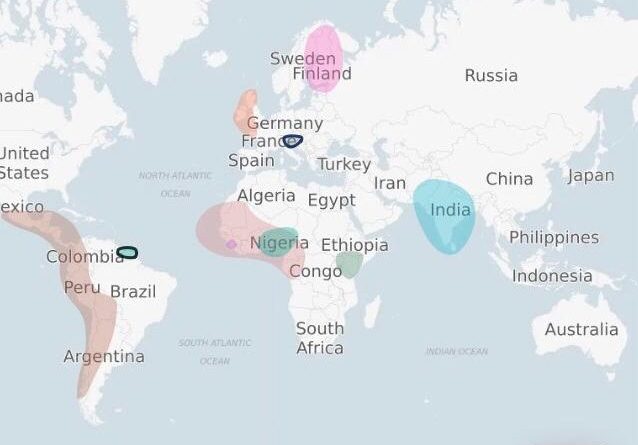
- DNA analysis also points to ancestral homelands from where our genes come. This is direct evidence for immigration, the subject of Voyaj. Below is an analysis of the ancestral homelands of one of our founders. Even though born in Dominica, many ancestors with their own histories and homelands contributed to the eventual making of this child. On the map we see direct scientific evidence for the Native American origin of Dominica’s Kalinago. Western European contribution, contribution from the West African bights of Biafra (Bonny) and Benin, and immigration from India to the Caribbean also paint the map. In some cases, we can sort which ancestors contributed what to this map for this individual? Having knowledge of, and being able to categorically answer the question: ‘Where are you from?’ empowers us.